




A gentle guide
How to groom a cat (or dog) who hates being groomed
A step-by-step way back to grooming, based on advice from UK animal charities. It takes about a week. No wrestling.
The brush comes out of the drawer. Before you've even sat down, they've gone: under the bed, behind the sofa, or flat-eared on your lap with the tail thumping. So the brush goes back in the drawer, and the fur goes on the sofa.
You're not doing anything wrong, and neither is your pet. Here's why it happens, and how to turn grooming into something they'll put up with, and maybe even look forward to.
Step 1
Why they hate it (it isn't stubbornness)
- Being held still. Cats in particular like to know they can leave. International Cat Care is clear that a cat should never be groomed or stroked by force, without the option to escape.
- How the tool feels. A hard or scratchy brush on sensitive skin, or bristles tugging on a knot, is enough to put most pets off.
- One bad memory. A session that went on too long, or a knot that pulled. They don't remember the reason, they remember the brush.
In most cases the problem isn't grooming itself. It's how grooming feels.
Step 2
Know when to stop
Your pet tells you long before the hiss or the snap. International Cat Care lists the signs a cat has had enough:
- the skin on their back ripples or twitches
- they turn their head sharply towards your hand
- their ears flick or rotate backwards
- they growl or hiss
Dogs show it differently: turning their head away, licking their lips, going stiff.
The golden rule: stop before these signs, not after. End every session while they're still relaxed, so the last thing they remember is a good one.
Step 3
A one-week reset
Days 1–2: let the tool live near them. Leave it by their bed or their bowl and let them sniff it. Bring it out at the same time as something they love, like a treat or their dinner. Blue Cross recommends exactly this for dogs who are scared of brushes.
Days 3–4: a few strokes, then stop. Start where they already love being touched, such as the cheeks or the top of the back. Three or four strokes, a treat, and you walk away first.
Days 5–7: a little longer, a little further. Add the sides and the back, a few strokes more each time. Always finish before the signs in step 2.
After that: little and often. International Cat Care suggests grooming short-haired cats at least once a week, and long-haired cats daily, but only for as long as they're comfortable. Expect more fur in spring and autumn, and the PDSA notes that central heating means many indoor cats shed all year round.
Step 4
Which tool for which pet (honestly)
| Your pet | What tends to work | Why |
|---|---|---|
| Nervous, older, or new to grooming | A grooming glove or a very soft brush | It feels like being stroked, not groomed |
| Long coat that knots easily | A comb or a detangling brush | A glove won't undo a knot |
| Heavy-shedding double coat, in moult | An undercoat rake or deshedding tool | It reaches the dead undercoat |
| Badly matted coat | Your vet or a professional groomer | Never pull on a mat at home |
There's no single right tool. As International Cat Care puts it, find what causes the least stress for everyone involved.
Free
Want the one-week reset by email?
We'll send you the day-by-day plan to keep on your phone, and a heads-up in spring and autumn when moulting season starts.
One email with the routine, then a short tip when moulting season starts. Unsubscribe any time. Privacy policy
Where Meoggy fits
The gentle start, for the ones who won't let anything else near them.
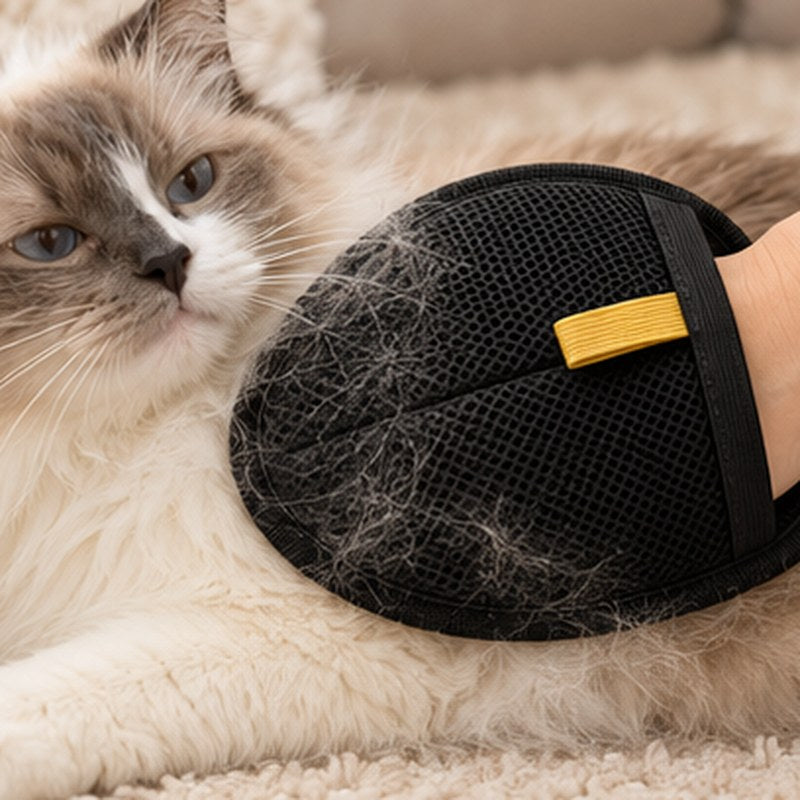
We made the Cuddle Glove for step 3. You slide your hand in and stroke the way you always do. The loose fur collects on the soft grey side, and when you're done you peel it off in one sheet and rinse the glove under the tap.
To be straight with you: it won't untangle knots, and it isn't a deshedding rake. It's for the pets who bolt at the sight of a brush.
From £19.99 · 30 days to try it at home
Or get it in the Fur-Free Kit, with the rake and the Fur Wiper · £49.99
30 days to try it at home
If your pet won't take to it, email us your order number and a photo and we'll refund you in full. No need to send anything back.
Sources: International Cat Care, Grooming your cat · PDSA, Why and when pets moult · Blue Cross, How to groom your dog. This guide is general advice; if your pet is in pain, has sore skin or a badly matted coat, see your vet.